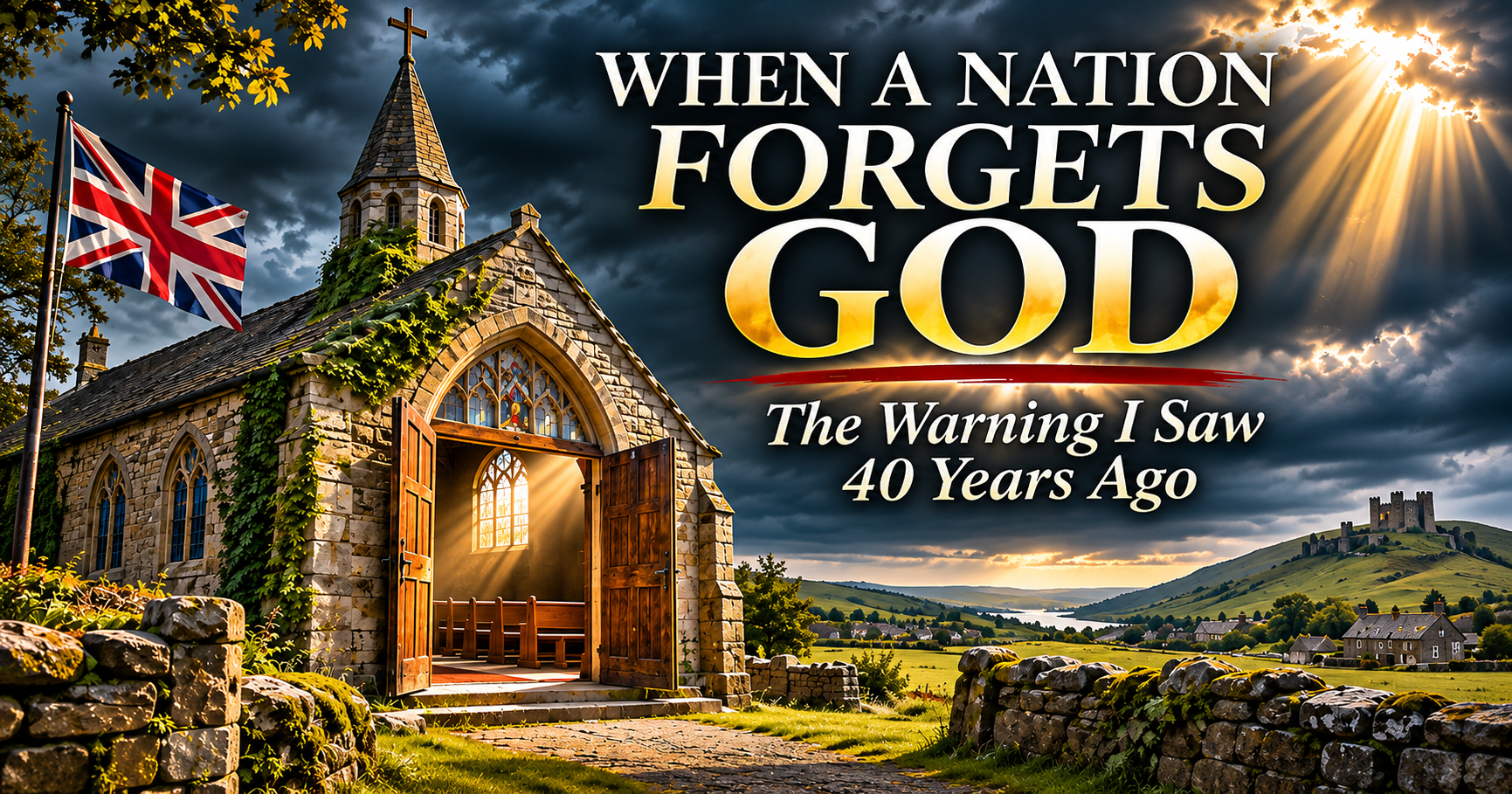
A Warning from Across the Atlantic
What Happens When a Nation Forgets God—and Is America Following the Same Path?
More than forty years ago, my husband Dwight and I traveled to the British Isles on a mission trip. I had no idea that something I would encounter during that journey would remain etched in my memory for the rest of my life.
It was the early 1980s, and we were ministering in a very small church. One evening, while the meeting was taking place, I noticed several young people standing outside, looking through the windows, apparently curious about what was happening inside. I decided to step outside and speak with them. I introduced myself and explained that we had traveled from America to share the Gospel of Jesus Christ and encourage believers to grow in their relationship with God.
As our conversation continued, I made a discovery that absolutely astonished me.
These young people knew virtually nothing about the Bible. They had never heard the story of Adam and Eve. They knew nothing about the Garden of Eden. They had no understanding of the biblical account of creation or the entrance of sin into the world. They did not know that, according to Genesis, God created mankind in His own image and placed the first man and woman in a beautiful garden where He provided everything they needed. They had never heard how Adam and Eve disobeyed God, bringing sin into human experience. And they had no understanding of why mankind needed a Savior.
I could hardly believe what I was hearing.
How Could They Not Know?
You must understand something about the world in which I grew up. As a child in America during the 1950s and early 1960s, I lived in a culture where biblical stories were familiar to almost everyone. We read the Bible in school. We prayed. At Christmas, we participated in programs celebrating the birth of Jesus Christ.
Even children who did not attend church generally knew about Adam and Eve, Noah and the Ark, Moses, David and Goliath, and the birth of Jesus. We understood that God was our Creator. We knew that sin was wrong. We knew that Jesus had died on the cross.
Of course, knowing Bible stories did not mean everyone was a Christian. There is an enormous difference between possessing biblical knowledge and surrendering your life to Jesus Christ. But at least the foundation was there.
Yet here I was, standing outside a little church in the British Isles, speaking with young people who had never heard the most basic accounts of Scripture. I remember thinking: How could a nation with such a rich Christian history have raised a generation that knew so little about God?
After all, this was the land that had produced great preachers, missionaries, theologians, and reformers. This was the land of John Wesley, George Whitefield, Charles Spurgeon, and countless others who had proclaimed the Gospel with tremendous courage. British missionaries had carried the message of Jesus Christ around the world. And now I was meeting young people who did not even know who Adam and Eve were.
I was witnessing something that deeply troubled me. A generation was growing up without the biblical foundation that previous generations had taken for granted. And I wondered what would happen to those nations if that trend continued.
Forty Years Later
Today, more than four decades later, we can look across the Atlantic and see how dramatically the religious landscape of Europe has changed. Many European nations that once identified strongly with Christianity have experienced substantial declines in church attendance and religious affiliation. Historic church buildings have closed, been sold, or been converted to other uses. In some communities, Christian congregations have dwindled while other religious communities, including Muslim congregations, have grown.
But the larger story is not simply about one religion growing while another declines. It is about the increasing influence of secularism and the loss of Christian belief among populations that once considered Christianity central to their national identity. For many Europeans, faith has become a private matter, a cultural tradition, or something they have abandoned altogether.
And the changes have not been confined to church attendance. Questions concerning marriage, family, sexuality, human life, education, and moral authority are now answered very differently than they were generations ago.
Of course, Europe’s economic and political challenges have many causes, including demographic changes, energy costs, government policies, and international conflicts. It would be inaccurate to attribute every hardship to declining religious belief. Nevertheless, as a Christian, I believe there is a deeper question worth asking.
What happens to a civilization when it progressively abandons the spiritual convictions that once helped shape its moral understanding?
The First Great Deception
To understand my concern, we must return to the beginning. Genesis tells us that God created the heavens and the earth. He created mankind in His own image. He placed Adam and Eve in the Garden of Eden, where they enjoyed His provision and fellowship. God’s creation was good.
But then came the serpent. And with the serpent came a question that has echoed throughout human history.
Did God really say?
That question challenged the authority of God’s Word. It invited mankind to question whether God could be trusted. And ultimately, Adam and Eve chose disobedience.
Genesis 3 describes the tragic consequences of that decision. Sin entered human experience, and with it came alienation from God, suffering, and death. Romans 5:12 teaches that sin entered the world through one man and that death came through sin. The biblical account of the Fall explains why humanity needs redemption. And that redemption is found in Jesus Christ.
But here is what troubles me. When a generation no longer understands creation, the Fall, and the nature of sin, how will it understand its need for a Savior? If people believe there is no Creator to whom they are accountable, why should they submit to His commandments? If sin is merely a matter of personal preference, why would anyone need to repent? And if mankind is capable of saving itself, why would anyone need Jesus Christ?
This is why biblical teaching is so important. Without an understanding of the problem of sin, the message of salvation loses its meaning.
Are We Following the Same Path?
When I look at America today, I see many of the same cultural changes that troubled me during that mission trip. Biblical literacy has declined. Many young adults have little familiarity with Scripture. Christianity is increasingly viewed as one belief system among many rather than the foundation of a shared national culture. And moral questions that were once widely discussed in biblical terms are now approached primarily through personal autonomy, individual rights, and secular reasoning.
Recent elections have highlighted how deeply divided Americans have become over abortion, gender identity, immigration, religious liberty, and the role of government. These are not merely political questions. Many of them involve fundamental disagreements about human nature, moral responsibility, the meaning of freedom, and the authority of God.
As Christians, we must be willing to examine these issues through Scripture. But we must also recognize that people who disagree with us are not necessarily motivated by hatred of God. Many sincerely believe their positions promote justice, compassion, and human dignity. Our responsibility is to proclaim what we believe to be true while demonstrating the character of Christ.
We must never allow political allegiance to become a substitute for biblical discernment. No political party perfectly represents the Kingdom of God. Our ultimate allegiance belongs to Jesus Christ.
The Responsibility We Have Neglected
Perhaps the greatest mistake Christians can make is to blame the spiritual condition of America entirely on politicians, educators, or secular institutions. Because the responsibility for making disciples was never given to the government. It was given to the Church.
And the responsibility for teaching children the ways of God begins in the home. Deuteronomy 6:6-7 instructs God’s people to impress His commandments upon their children and speak of them throughout everyday life.
Think about that. God intended His Word to be woven into the daily experience of the family. Not merely discussed on Sunday mornings. Not delegated entirely to a Sunday school teacher. Not treated as an optional subject. Parents were to teach their children who God is, what He requires, and why His commandments matter.
But somewhere along the way, many Christian families became consumed with other priorities. Education. Sports. Careers. Financial success. Entertainment. Personal comfort. And the spiritual formation of our children gradually became secondary.
We taught them how to succeed in the world. But did we teach them how to walk with God? We prepared them for college. But did we prepare them for eternity? We encouraged them to pursue their dreams. But did we teach them to surrender their lives to Jesus Christ?
What good is worldly success if our children never come to know the Lord?
When the Church Loses Its Voice
I believe the decline in biblical knowledge also reveals a serious failure within the Church. We have often become more concerned about attracting people than discipling them. We have created programs designed to entertain children and young people while neglecting the serious teaching of Scripture. We have emphasized God’s blessings while minimizing His holiness. We have spoken endlessly about His love while becoming increasingly reluctant to discuss repentance, judgment, and obedience.
But the Gospel cannot be understood apart from the character of God. He is loving. He is merciful. He is patient. But He is also holy, righteous, and just.
Habakkuk 1:13 describes God’s purity and His opposition to evil. Hebrews 12:14 reminds believers of the necessity of holiness. And Jesus Himself declared that those who would follow Him must deny themselves, take up their cross, and follow Him.
That is not a message of comfortable Christianity. It is a call to complete surrender.
The Church was never commissioned to make people comfortable in their sins. We were commissioned to make disciples of Jesus Christ.
What About the Growth of Islam?
Another significant change in Europe, and increasingly in America, is the growing religious diversity of our societies. Muslim communities have expanded in many Western countries through immigration, family growth, and other demographic changes.
As Christians, we should take religious differences seriously. Christianity and Islam make fundamentally different claims about the identity of Jesus Christ, His crucifixion, His resurrection, and the nature of salvation. Those differences matter. I believe Jesus Christ is the Son of God, the crucified and risen Savior, and the only way to the Father. John 14:6 is central to that conviction.
But we must distinguish theological disagreement from hostility toward people. Muslims, like everyone else, are individuals created in the image of God. Their presence in our communities does not make them enemies. Our calling is to proclaim Christ faithfully, defend religious freedom, and love our neighbors.
The early Church did not spread the Gospel through fear of people who believed differently. It spread through courageous witness, sacrificial love, prayer, and the power of the Holy Spirit. That is the example we must follow.
The answer to religious and cultural change is not fear. It is a Church that knows its God and faithfully proclaims His Gospel.
The Gospel Must Begin with the Beginning
I often think back to those young people standing outside that little church. They had no understanding of creation. They did not know about the Fall. They had never heard the story of Adam and Eve. And therefore, they had no foundation for understanding why Jesus Christ came into the world.
That experience taught me something I have never forgotten. We cannot assume that people know the Bible. We cannot assume that they understand sin. We cannot assume that they know who Jesus is. And we certainly cannot assume that attending church means someone has been born again.
We must return to teaching the whole counsel of God. Creation. The Fall. Sin. Judgment. Repentance. Redemption. The cross. The resurrection. The new birth. The indwelling Holy Spirit. Holiness. Obedience. And the glorious return of Jesus Christ.
These are not optional subjects. They are foundational truths of the Christian faith. And if we fail to teach them, we should not be surprised when future generations grow up without them.
The Warning Is Before Us
When I stood outside that little church more than forty years ago, I could not have imagined how much the Western world would change during my lifetime. Today, I look at America and wonder whether we are repeating the same mistakes.
We have enjoyed extraordinary blessings. We have possessed tremendous freedom. We have had access to more Bibles, churches, Christian books, broadcasts, and teaching resources than almost any generation in history. Yet biblical ignorance continues to grow.
How can that be?
Perhaps because access to the Word of God is not the same as obedience to the Word of God. Perhaps because religious activity is not the same as spiritual life. And perhaps because we have become so comfortable with the blessings of God that we have neglected the God who gave them.
Second Timothy 3:5 warns about people who maintain an outward appearance of godliness while denying its power. Could that describe portions of the modern American Church? We have beautiful buildings. Professional programs. Impressive technology. And enormous religious organizations.
But where is the fear of the Lord? Where is the brokenness over sin? Where is the hunger for righteousness? Where is the commitment to making disciples who obey Jesus Christ?
We do not need a more entertaining Church. We need a more obedient Church.
It Is Not Too Late to Return
I do not believe Christians should surrender to despair. God is still merciful. Jesus Christ is still saving sinners. The Holy Spirit is still transforming lives. And the Gospel remains the power of God for salvation to everyone who believes.
But we must recognize the seriousness of our responsibility. We cannot turn back the clock. We cannot force an entire nation to embrace Christianity. And we cannot manufacture genuine revival through political power.
But we can repent. We can pray. We can teach our children. We can proclaim the Gospel. We can demonstrate holiness in our homes and churches. And we can surrender ourselves completely to the Lordship of Jesus Christ.
That is where spiritual renewal begins. Not in Washington. Not in Parliament. Not in political parties. But in hearts that have been transformed by the living God.
A Final Word
More than forty years ago, I stepped outside a small church in the British Isles to speak with a group of curious young people. I thought I was simply going to explain why we had come to their community. Instead, I discovered how easily an entire generation could grow up without knowing the foundational truths of Scripture.
I have never forgotten that evening. And today, as I look at the spiritual condition of America, I believe the lesson is more important than ever.
A nation can possess a rich Christian history and still raise generations that do not know the God of the Bible. A nation can have churches on every corner and still be spiritually impoverished. A nation can celebrate its religious heritage while abandoning the very truths that heritage proclaimed. And a Church can become so occupied with maintaining its institutions that it forgets its mission.
The answer is not nostalgia for a bygone America. The answer is a return to Jesus Christ. To His Word. To His holiness. To His commandments. To genuine repentance. And to the making of disciples.
Because if we fail to teach this generation who God is, we should not be surprised when the next generation lives as though He does not exist.
The question is no longer whether the culture is changing. It is. The question is whether the Church will awaken to its responsibility before another generation grows up without knowing the Savior.
May God awaken His Church!
“My people are destroyed from lack of knowledge.”
Connie Cenac
If this message has challenged your heart, please share it. The next generation desperately needs to know the God who created them, the Savior who died for them, and the Lord who calls them to follow Him.
Enjoyed this post?
Get daily meditations and encouragement delivered to your inbox