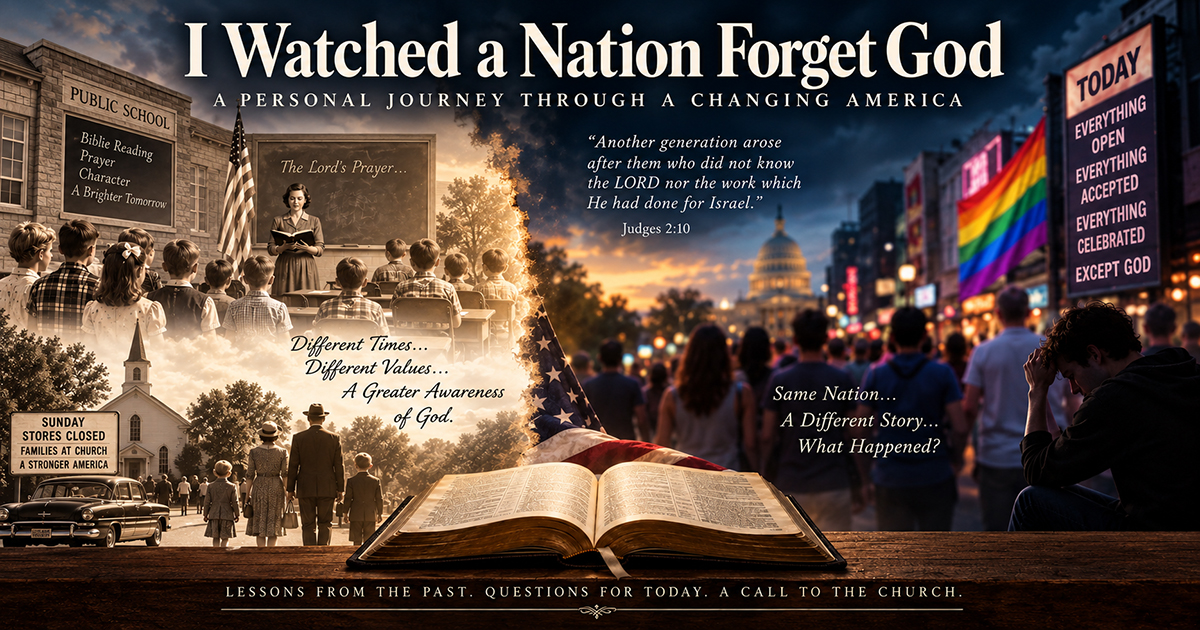
I Watched a Nation Forget God
I have lived long enough to remember a very different America. When I was a little girl growing up in the 1950s, God was not a stranger in our everyday lives. In many communities, public schools included practices such as Bible reading, recitation of the Lord’s Prayer, or other forms of religious observance. Before we ate our lunch, we often blessed our food. Those practices were not uniform across the country, and they did not mean that every child or family was Christian. They also existed within a nation where religious freedom, denominational differences, and serious injustices were always part of the larger story. But in the communities I knew, faith was openly woven into ordinary life in a way that is far less common today.
At Christmas, we did not have to explain to children who Jesus was. Every year there were Christmas programs and nativity scenes. Children knew about Mary and Joseph. They knew about the shepherds, the angels, and the baby born in Bethlehem. Were we all Christians? Absolutely not. Was America perfect? Certainly not. There were terrible sins and injustices in our country then, just as there are today. The religious customs of that era sometimes existed alongside hypocrisy, exclusion, and unequal treatment of others. But there was something we had then that I believe we have largely lost today: a consciousness of God.
Even people who did not attend church often understood that there was a God, that certain things were right, certain things were wrong, and that ultimately we were accountable to Someone greater than ourselves. I have watched that consciousness gradually disappear during my lifetime. And it did not happen overnight.
I Remember When Things Began to Change
When I was young, Sunday was different from every other day of the week. In many places, stores were closed or operated under blue laws that restricted Sunday commerce. Families went to church, rested, visited relatives, or treated the day as set apart. Sunday was commonly regarded as the Lord’s Day, even though not every community observed it in the same way and not everyone agreed with those laws. Then I remember when some stores began opening at one o’clock in the afternoon. The reasoning seemed to be, “People have already had time to go to church.” It probably seemed like such a small thing. But that is how cultures change. One boundary moves. Then another. Then another. Eventually the generation that remembers why the boundaries existed is gone, and the next generation inherits a culture without understanding what was lost.
The same thing happened with sexual morality. When I was young, sex outside marriage was widely considered wrong in the communities I knew. Pregnancy outside marriage carried tremendous social consequences. Divorce was viewed very differently than it is today. That was not the whole country’s experience, and the standards were not always applied fairly. Women often carried more of the shame and consequences than men did. Some people remained trapped in abusive marriages because divorce was so stigmatized. Others hid painful circumstances because they feared what their communities would think. I am not suggesting everything about that culture was good. But underneath it was still a widespread public understanding that marriage, family, sexual faithfulness, and personal morality mattered.
Today, many of the biblical standards that were once broadly recognized are rejected or disputed in the wider culture. Sexual relationships outside marriage, same-sex relationships, and questions surrounding gender and identity are approached very differently from the biblical convictions with which I was raised. The law, public institutions, and social customs have also changed over time, reflecting a more religiously diverse and individualistic society. But here is what concerns me even more: many people no longer know what the Bible says at all. You cannot expect people to obey a God they do not know.
What Happened?
In 1962, the United States Supreme Court ruled in Engel v. Vitale that a state-composed prayer could not be required in public schools. The following year, in Abington School District v. Schempp, the Court ruled against state-required devotional Bible reading and recitation of the Lord’s Prayer in public schools. Those decisions did not make private prayer, voluntary religious expression, or the study of religion illegal. They addressed government-sponsored devotional practices in public schools. Students and teachers did not lose every right to pray or discuss faith; rather, public schools were not permitted to lead students in religious exercises as part of the school day.
Years later came another decision involving the posting of the Ten Commandments in public-school classrooms. That legal history has also been more specific and complicated than a simple statement that the Bible was “removed from America.” Courts have distinguished between devotional religious instruction and the academic study of religion, history, literature, and culture. Still, those decisions were significant cultural milestones. They reflected and accelerated a broader movement toward keeping government institutions religiously neutral.
But I do not believe we can simply point toward Washington, the Supreme Court, or the public schools and say, “There is the problem.” The problem is much deeper. Because government did not receive the Great Commission. The Church did. Jesus did not command the government to make disciples. He commanded us. “Go therefore and make disciples of all the nations… teaching them to observe all things that I have commanded you.” — Matthew 28:19–20. So perhaps we have been asking the wrong question. Instead of only asking: “How did they take God out of our culture?” maybe the Church needs to ask: “How did we fail to carry the knowledge of God faithfully into the next generation?” That question is much harder.
Another Generation Arose
There is a frightening verse in Judges that I believe speaks directly to us: “When all that generation had been gathered to their fathers, another generation arose after them who did not know the LORD nor the work which He had done for Israel.” — Judges 2:10. Think about that. These were the descendants of people who had experienced the supernatural works of God. Their parents and grandparents had stories. They had testimonies. They had history. And somehow another generation arose that did not know the Lord. How does that happen? It happens when one generation knows God but the next generation only knows about Him. Then the following generation may not know Him at all. That is why discipleship matters so much.
Christianity was never supposed to be a Sunday-morning experience passed casually from one generation to another. God commanded Israel: “And these words which I command you today shall be in your heart. You shall teach them diligently to your children…” — Deuteronomy 6:6–7. First, in your heart. Then, teach them diligently to your children. That is God’s pattern.
Romans 1 Shows Us the Progression
Romans 1 describes something else that should get our attention: “Although they knew God, they did not glorify Him as God, nor were thankful…” — Romans 1:21. Notice where the decline begins. It does not begin by saying there is no God. It begins when people know God but refuse to honor Him as God. God is moved from the center toward the edges. His Word becomes optional. His commandments become suggestions. Eventually human beings begin deciding for themselves what is good and what is evil. And that is an ancient temptation. It goes all the way back to the Garden. The serpent’s question was essentially: “Did God really say?” We are still answering that question.
But I Am Not Writing This to Condemn the World
This is where I believe the Church must be very careful. It is easy for Christians to look at the condition of America and become angry at unbelievers. But why should we expect people who do not know Christ to live like people who do? The world needs Jesus. And our assignment is not merely to win cultural arguments. Our assignment is to make disciples. We must preach repentance. We must preach the cross. We must preach the blood of Jesus. We must preach holiness. We must preach the resurrection. We must preach the coming Kingdom. And then we have to live what we preach. The greatest evidence for Christianity is not a Ten Commandments plaque hanging on a classroom wall. It is a life transformed by Jesus Christ.
Cultural Christianity Was Never Enough
Looking backward has also taught me something important. Having prayer or Bible reading in a public school did not mean everyone was saved. In some places, those practices were voluntary or locally established; in others, they were government-led and later challenged in court. Either way, their presence did not guarantee genuine faith. Having stores closed on Sunday did not mean everyone was born again. Knowing the Lord’s Prayer did not mean someone had surrendered his life to Jesus Christ. A nation can have Christian traditions without having transformed hearts. That is why I do not simply want the America of my childhood back. I want something deeper.
I want to see genuine repentance. I want to see men and women born again. I want to see fathers become spiritual leaders in their homes. I want to see mothers teaching their children the Word of God. I want to see young people who do not merely inherit their parents’ Christianity but encounter Jesus Christ for themselves. I want to see churches making disciples instead of simply filling buildings. I want to see pastors preach the whole counsel of God without fear. I want to see Christians whose lives demonstrate that Jesus truly is Lord.
The Answer Is Not Nostalgia. The Answer Is Revival.
At my age, I can look backward and remember things younger generations have never experienced. But I refuse to spend the rest of my life simply talking about how wonderful things used to be. God did not put us here to mourn yesterday. He put us here to occupy until He comes. The darker the world becomes, the brighter the light of Christ should shine through His people. Jesus said: “You are the light of the world. A city that is set on a hill cannot be hidden.” — Matthew 5:14. Maybe God has allowed some of the props of cultural Christianity to disappear so that the real Church will once again understand who we are.
We do not need America merely to become more religious. America needs Jesus. Our children need Jesus. Our grandchildren need Jesus. Our churches need Jesus. And sometimes, if we are honest, those of us who have walked with Him for decades need to fall in love with Him all over again.
I Watched a Nation Forget God
I have watched enormous changes take place during my lifetime. I remember communities where children prayed in school or participated in school-sponsored religious observances before the courts clarified the limits of government involvement. I remember Bible reading in public schools, though I now understand more clearly that such practices varied by place and were not always voluntary or constitutionally permissible. I remember when Sunday looked different, with many businesses closed or restricted by local laws and customs. I remember when biblical morality was generally understood, even by many people who did not practice it, though that understanding often coexisted with serious hypocrisy and injustice.
And now I am watching another generation grow up in a culture where millions of people have little understanding of the Bible or the God who wrote it. But I am not without hope. Because God has always worked through a remnant. One surrendered person can affect a family. One surrendered family can affect a neighborhood. One Spirit-filled church can affect a city. And a generation truly awakened to Jesus Christ can affect a nation.
So maybe the most important question is not: “What happened to America?” Maybe it is: “Church, what are we going to do now?” We cannot change yesterday. We cannot force people to believe. But we can preach the Gospel. We can make disciples. We can teach our children. We can live holy lives. We can love people enough to tell them the truth. We can refuse to compromise the Word of God. And we can cry out once again: “Lord, send revival—and begin with us.” Because the greatest tragedy would not be that I lived long enough to watch a nation forget God. The greatest tragedy would be for those of us who still know Him to remain silent while another generation grows up without Him.
Enjoyed this post?
Get daily meditations and encouragement delivered to your inbox