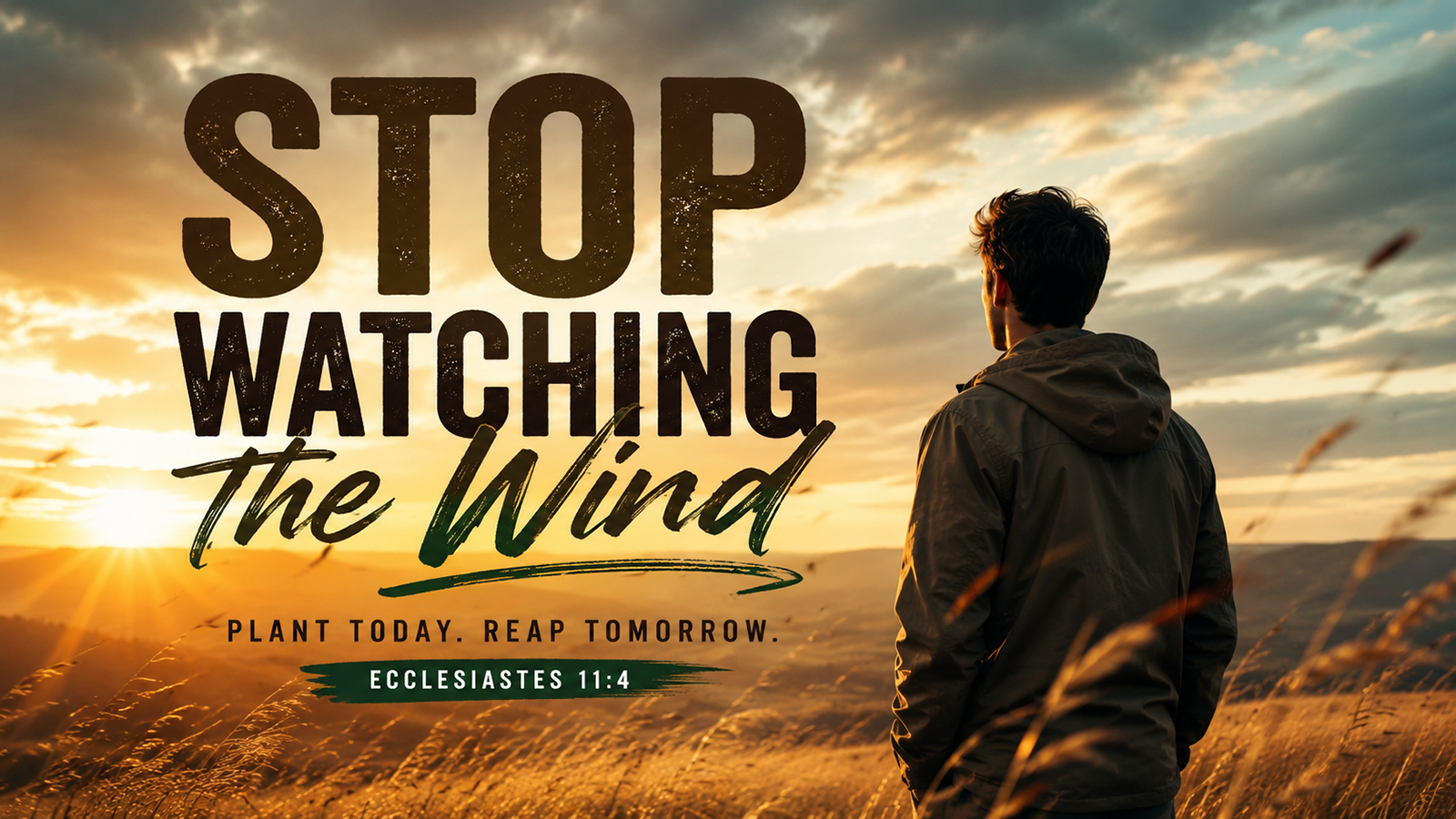
Stop Watching the Wind
"He that observeth the wind shall not sow; and he that regardeth the clouds shall not reap."
— Ecclesiastes 11:4
This verse is short, but it carries a weight that speaks directly into the struggle between faith and hesitation, between obedience and over-calculation, between stepping forward and waiting for everything to feel safe.
There is a kind of paralysis that many people live with—not because they are unwilling to act, but because they are waiting for ideal conditions. Waiting for clarity. Waiting for confirmation. Waiting for the fear to disappear. Waiting for the timing to feel perfect. And yet, Scripture speaks directly into that tendency with a simple agricultural image that anyone in ancient Israel would have understood immediately.
If a farmer waits for perfect wind conditions, perfect skies, perfect forecasts, perfect emotional confidence, he will never plant. And if he never plants, there will never be a harvest. The warning is not subtle. Hesitation, when it becomes a lifestyle, quietly becomes a thief of destiny.
The illusion of perfect conditions
One of the greatest illusions we deal with in life is the belief that there will come a moment when everything aligns so perfectly that courage will no longer be required. We imagine a future version of ourselves who feels more ready, more equipped, more confident, more certain.
But life rarely works that way. In most cases, obedience to God’s direction happens in conditions that feel incomplete. There is always wind in the picture. There are always clouds moving across the sky. There is always something uncertain enough to justify delay.
The farmer in Ecclesiastes 11:4 is not foolish. He is observant. He is paying attention. He is aware of the environment. But his problem is not awareness—it is over-dependence on it. He has allowed observation to replace action.
And that is where many people get stuck. They confuse wisdom with hesitation. They think that because they can identify risks, they should wait until all risks are gone. But wisdom in Scripture is not the absence of risk—it is obedience in spite of it.
When caution becomes disobedience
There is a difference between prudence and paralysis. Prudence considers wisely; paralysis refuses to move. Prudence counts the cost; paralysis never builds anything because the cost always feels too high.
At some point, excessive caution stops being wisdom and starts becoming fear wearing a mask.
The tragedy is that fear rarely announces itself honestly. It doesn’t say, “I am afraid.” Instead, it says, “I am being careful.” It says, “I am waiting on peace.” It says, “I just need more confirmation.” It sounds responsible, even spiritual at times.
But Ecclesiastes 11:4 cuts through that reasoning. It exposes the farmer who is endlessly analyzing wind patterns while the soil sits untouched. It reveals a truth that is uncomfortable: not planting is still a decision, and it is a decision that guarantees no harvest.
The spiritual principle of seed time
Throughout Scripture, seed time and harvest is more than agriculture—it is a spiritual law. What you sow, you eventually reap. But sowing always requires action before results are visible.
You plant in faith before you see fruit. You water in faith before you see growth. You wait in faith before you see harvest.
And that is where the tension lives. Faith is not passive. Faith moves when conditions are still uncertain. Faith steps out while the wind is still blowing.
If everything had to feel safe before obedience, then faith would no longer be faith. It would simply be calculation.
The danger of waiting too long
There is a subtle danger in delayed obedience. It does not feel like rebellion. It feels like preparation. It feels like responsibility. It feels like “not yet.”
But delay, when God has already spoken, becomes a quiet form of resistance.
Many people do not fail because they made the wrong decision. They fail because they never made any decision at all. They waited themselves out of opportunity. They waited themselves out of timing. They waited until the moment passed and then called it wisdom.
Ecclesiastes 11:4 is a warning that opportunity is seasonal. There is a time to plant, and there is a time to reap. But if you miss the planting season because you were studying the wind, you cannot manufacture a harvest later through regret.
Faith requires motion, not just belief
It is easy to say we have faith while remaining completely still. But biblical faith always has movement attached to it. Abraham did not become the father of nations by analyzing geography. He left. Noah did not build an ark after the rain started. He built it while people mocked him. Peter did not experience walking on water from the boat while debating weather patterns. He stepped out.
In every case, faith required action before certainty.
This is where Ecclesiastes 11:4 becomes so practical. It is not just about farming—it is about living. There will always be wind. There will always be clouds. There will always be enough uncertainty to justify staying where you are.
But staying becomes dangerous when God has already called you forward.
The cost of overthinking
Overthinking feels productive. It creates the illusion of progress because the mind is active, the analysis is deep, and the reasoning feels thorough. But thinking is not the same as building, and reflection is not the same as planting.
A person can spend years “preparing” and never actually move forward. They can accumulate information without ever producing transformation.
The wind-watcher in Ecclesiastes is not lazy. He is distracted by variables he cannot control. And in focusing on what he cannot control, he neglects what he can: sowing the seed.
This is one of the greatest traps of the human mind—we often fixate on conditions rather than obedience.
Trusting God in imperfect conditions
Faith does not ignore reality; it transcends it. The farmer does not pretend the wind is not blowing. He simply refuses to let the wind dictate whether or not he obeys the natural process of planting.
In the same way, trusting God does not mean denying challenges. It means refusing to let challenges become the authority over your obedience.
God never promised that the environment would be ideal. What He promised is that He would be present in the process.
When you plant in faith, you are not planting into perfect soil conditions—you are planting into God’s faithfulness.
The harvest belongs to the obedient
One of the quiet truths in this verse is that harvest is not only about timing—it is about participation. You cannot reap what you never sowed.
There is a level of frustration in life that has nothing to do with external opposition and everything to do with internal hesitation. People often pray for harvests they have never planted toward. They desire outcomes they have never risked anything for.
Ecclesiastes 11:4 gently corrects that thinking. It reminds us that motion precedes multiplication. Action precedes increase.
Moving forward anyway
The call of this verse is not recklessness—it is courage anchored in trust. It is not ignoring wisdom—it is refusing to be imprisoned by uncertainty.
There will always be reasons to wait. But there will also always be a quiet prompting to move.
And often, the difference between a life of fruitfulness and a life of regret is not talent, intelligence, or opportunity. It is willingness to plant when the wind is still uncertain.
Closing reflection
Ecclesiastes 11:4 is ultimately a call to action disguised as agricultural wisdom. It speaks to the part of us that wants guarantees before obedience. It challenges the part of us that believes safety should come before stepping out.
But life, as Scripture presents it, is not lived in guarantees. It is lived in trust.
Whoever watches the wind will not plant. Whoever looks at the clouds will not reap.
The question underneath it all is simple: how long will you watch, and when will you begin to plant?
Because at some point, the future you are waiting for will only come through the seed you are willing to sow today.
Enjoyed this post?
Get daily meditations and encouragement delivered to your inbox